Brian Sims
Editor
Brian Sims
Editor

MERCURY SECURITY – the open architecture access control hardware specialist and an HID brand – has just issued its 2026 Trends in Access Controllers Report, duly revealing how changing cyber security requirements, interoperability needs, cloud adoption and emerging technologies are placing a greater emphasis on the active role controllers play when it comes to long-term physical access control strategy.
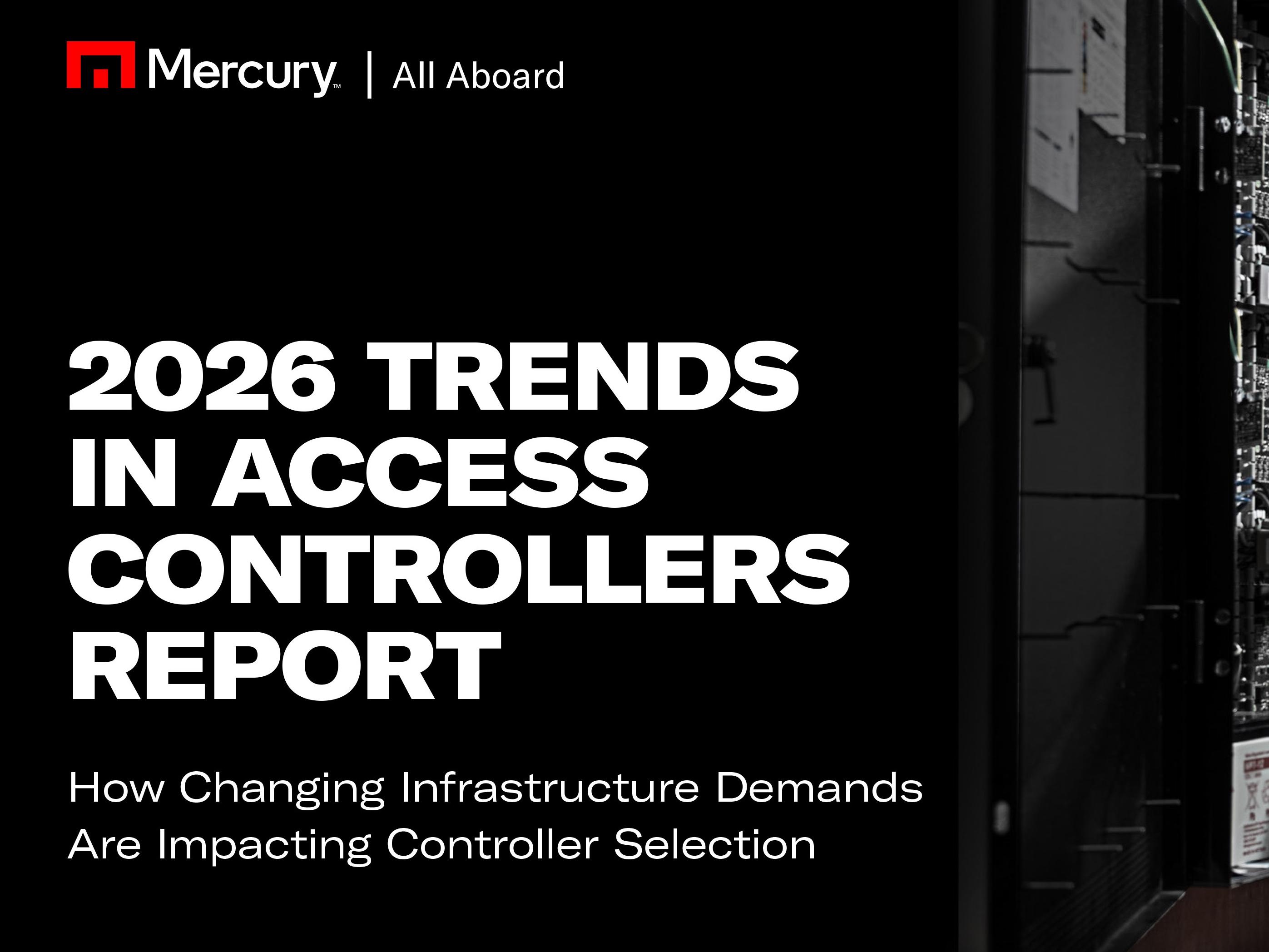
Based on a global survey of over 560 physical security and cyber security professionals (among them administrators responsible for access control management, systems integrators, installers and end users), the report finds that 78% of respondents consider the controller important or otherwise critical to their physical access control system (PACS) strategy. That figure is up from 72% in the 2025 survey.
This growth reflects controllers’ expanding role in the security environment. As they connect more devices, systems and applications across the security environment, organisations are placing greater importance on infrastructure that can address current requirements, while supporting new capabilities over time.
Cyber security represents one of the clearest gaps between respondents’ requirements and their existing infrastructure. 32% of them suggest that cyber security features are missing from their current controller systems, which is up from 21% in 2025. The gap emerges as 74% of respondents reported their belief that cyber security and IT co-ordination have become more complex to manage, even as 86% say their organisations actively work to remain current with changing cyber security and data protection standards.
“Organisations recognise the cyber security risks facing connected access control systems,” said Steve Lucas, vice-president of sales at Mercury Security, “but the infrastructure in place isn’t always keeping pace. As they look to modernise, end users also want to protect existing investments. That makes interoperability increasingly important and puts more weight on choosing controller platforms that can address current security requirements, while in parallel providing the flexibility to support what comes next.”
Influence on purchasing
69% of respondents identified interoperability as a critical factor in controller procurement, while 82% said that backward and forward compatibility is important in terms of future infrastructure planning.
The findings point to a preference for gradual modernisation that protects existing investments, while also affording organisations the flexibility to adopt new capabilities over time.
Mobile credentials are influencing those decisions as well, with half of respondents already using or otherwise planning to adopt mobile solutions and 46% of them ranking mobile credential integration among those trends driving controller purchases.
Cloud connectivity ranked among the leading factors influencing controller purchases, being cited by 56% of respondents. That’s up from 50% in 2025. However, only 41% reported that their controllers are currently cloud-enabled, while 26% stated that cloud enablement is missing from their existing systems. These findings suggest interest in cloud capabilities is growing faster than current infrastructure can support them.
New infrastructure demands
Behavioural analysis and anomaly detection rose from 44% in 2025 to 56% in 2026, while facial recognition was cited by 60% and predictive security and threat prevention by 50%. As these applications advance, processing power, storage, connectivity, cyber security and integration architecture are becoming greater considerations in the domain of controller selection.
More than 39% of respondents are also exploring (or have already adopted) edge computing within their security ecosystems, while 41% have integrated controller data with building occupancy and usage programmes, thereby demonstrating how access control infrastructre can increasingly support applications beyond traditional door control.
Taken together, the findings show how controller selection is evolving from a hardware purchase into a longer-term infrastructure strategy. Organisations are balancing immediate priorities such as reliability and cyber security with the need to support future technologies, integrate with surrounding systems and modernise without replacing infrastructure all at once.
*The 2026 Trends in Access Controllers Report is available to view online
Western Business Media Limited
Dorset House
64 High Street
East Grinstead
RH19 3DE
UNITED KINGDOM